
How glass and polycarbonate roofs trap the sun’s heat
A conservatory overheats because sunlight passes through the glass, warms the floor, furniture and walls, and that heat can’t easily get back out. That’s solar gain. In a room that’s mostly glass, it’s far stronger than in an ordinary room with a couple of windows. On a bright spring day a conservatory can be uncomfortably warm while the rest of the house still has the heating on.
Why the roof matters most
The roof faces the sky and catches the sun for more of the day, and at a steeper angle, than the walls do. Clear glass and polycarbonate roofs let a lot of solar energy through, and warm air collects up at the ridge. That’s why sitting in a conservatory at midday can feel like sitting in a greenhouse, even with the doors open.
Does opening the vents and doors solve it?
Opening roof vents and doors helps, but rarely enough on a sunny afternoon. Some warm air gets out, but on a still day the sun keeps putting heat in faster than it can escape. Open doors also let in insects and pollen and mean the room can’t be left open when you go out.
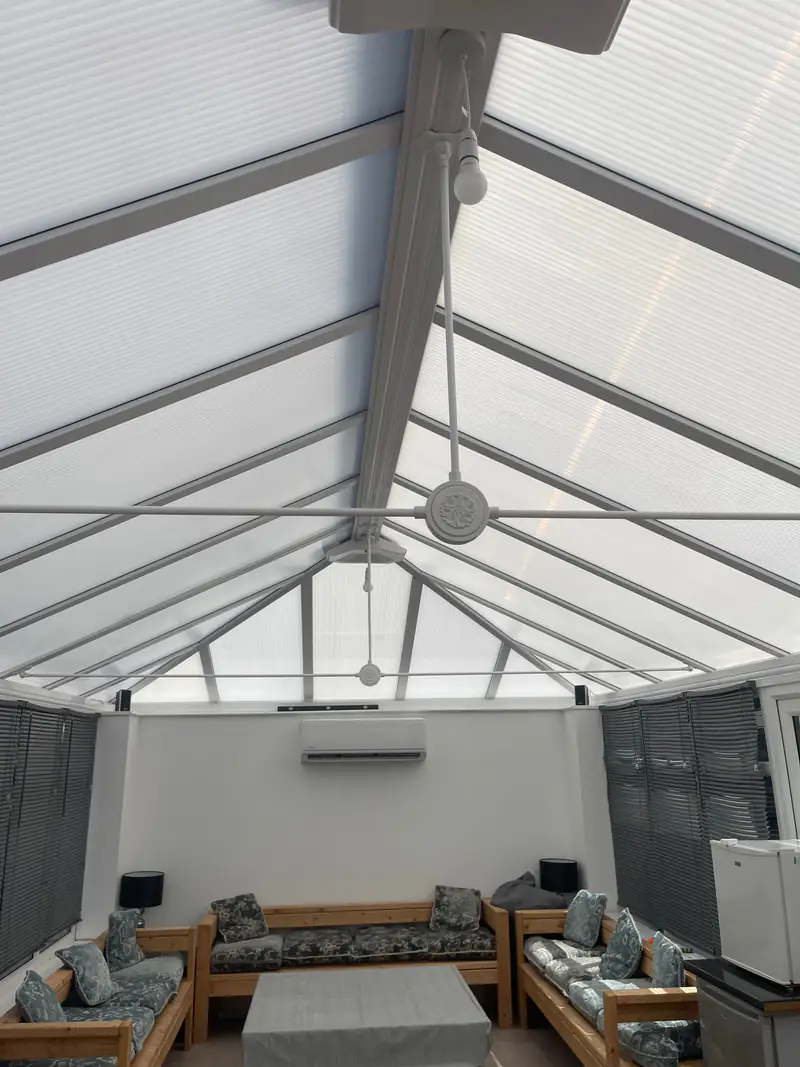
The winter problem: warmth escaping through the glazing
In winter the same glass works against you. Even good double glazing loses heat far faster than an insulated cavity wall, and older polycarbonate roofs lose it faster still. A conservatory that’s unbearable in July can be too cold to sit in from November to March, so many end up shut off for half the year.
Small electric heaters and an extended radiator often struggle against that rate of heat loss, and plug-in heaters can be expensive to run for long periods. Because conservatory air conditioning uses a reverse-cycle heat pump, the same unit that cools the room in summer provides efficient heating in winter, typically delivering several units of heat for each unit of electricity used. Heating performance is shown by the SCOP rating; the higher the number, the more efficient the system.
Condensation on cold glass
Cold glass and humid air cause condensation. Keeping the room at a steadier temperature, and the unit’s ability to remove moisture when cooling or in dry mode, can help reduce it. It may not eliminate condensation entirely, especially with older or poorly sealed glazing.
Sizing a system for a glazed room
Conservatories need more cooling and heating capacity than a solid room of the same floor area, sometimes considerably more. Rule-of-thumb figures that work for a bedroom can badly undersize a conservatory, and you end up with a unit running flat out that still can’t cope on sunny afternoons or cold nights.
| Factor | Why it matters |
|---|---|
| Glazing area | More glass means more solar gain in summer and more heat loss in winter. |
| Roof type | Clear glass and polycarbonate roofs add far more load than solid insulated roofs. |
| Orientation | South- and west-facing rooms gain much more heat than north-facing ones. |
| Glass specification | Solar-control and low-emissivity coatings reduce both gain and loss. |
| Shading | Trees, neighbouring buildings and blinds reduce the sun reaching the room. |
| Connection to the house | Whether doors to the house are kept closed or the room is open-plan with the kitchen. |
| How the room is used | A dining room used in the evening differs from a home office used all day. |
Orientation and the sun’s path
South-facing conservatories
These catch the sun for most of the day and get the strongest midday gain. They need the most cooling capacity, though they also benefit from free warmth on bright winter days.
West-facing conservatories
West-facing rooms take low, strong afternoon and evening sun when the room is already warm, so they often feel hottest at exactly the time people want to use them.
East- and north-facing conservatories
East-facing rooms warm up in the morning and cool through the afternoon. North-facing rooms gain the least heat in summer but are often the coldest in winter, so heating capacity becomes the priority.
Why oversizing isn’t the answer
An oversized unit cools the air quickly, switches off, then switches back on, which is less efficient, less comfortable and less effective at removing humidity. Modern inverter units can vary their output over a wide range, so you want one that copes with the peaks but spends most of its time running gently at low output.
Glass, polycarbonate or a solid replacement roof?
Nothing affects how comfortable a conservatory is as much as the roof, and it changes what size of system you need. If you’re planning to replace the roof, it’s worth doing that before sizing the air conditioning.
| Roof type | Summer heat gain | Winter heat loss | Notes |
|---|---|---|---|
| Polycarbonate | High | High | Common on older conservatories; can be noisy in heavy rain and may discolour over time. |
| Standard glass | High | Moderate to high | Clearer and quieter than polycarbonate, but still lets in a lot of solar heat. |
| Solar-control glass | Reduced | Moderate | Coated glass that reflects part of the sun’s energy while keeping the room light. |
| Solid or tiled replacement roof | Much lower | Much lower | Behaves more like an extension; may need Building Regulations approval. |
Solid and tiled replacement roofs
Replacing a glazed roof with an insulated solid or tiled roof greatly reduces both overheating and winter heat loss, often with roof lights to keep some daylight. It usually means a smaller air conditioning unit can do the job. Because a solid roof changes how the structure behaves, check with building control, and with the planning authority if your property is listed or in a conservation area.
Floor-standing consoles when there’s no wall to spare
The big practical problem in a conservatory is the lack of solid wall. Wall-mounted units need a sound, solid surface high up, and in many conservatories the only candidate is the house wall, which is often taken up by patio doors or a window.
Floor-standing console units
Compact units that sit low on the floor or fix to a dwarf wall. They’re designed to deliver air upwards for cooling and outwards at low level for heating, which suits a glass room well.
Wall-mounted on the house wall
Where there’s enough solid wall above the doors, a high-wall unit can work well and keeps the floor clear. Airflow must reach the far end of the room.
Units in an adjoining room
Occasionally, where the conservatory is fully open to a kitchen or dining room, a unit in the main room can serve both, though this suits only certain layouts.
What console positioning needs
- Clear space in front so furniture doesn’t block airflow.
- A solid fixing point and a route for pipework through a dwarf wall or the house wall.
- A condensate route that falls to a drain, or a suitable condensate pump.
- Access for filter cleaning without moving heavy furniture.
- A position away from the doors you use most.
Where should the outdoor unit go?
The outdoor unit should go somewhere with free airflow, a short and neat pipe route to the conservatory, and as little impact on neighbours and garden as possible. Usually that means on the ground against a dwarf wall, on a bracket on the house wall, or round the side. Keep it out of enclosed corners and away from neighbours’ windows, which matters even more in quiet villages like Haxby or Copmanthorpe, where there’s little background noise to mask a hum.
Practical outdoor unit points
- Allow the manufacturer’s clearances so the unit can draw in and discharge air.
- Use anti-vibration mounts and a level base or sturdy bracket.
- In heating mode the outdoor unit produces water as it defrosts, so plan where that drains.
- Leave access for servicing, and avoid spots where leaves collect against the coil.
- Consider appearance from the garden and patio; a discreet position is usually possible.
Blinds, films and ventilation: easing the load
A few simple changes take some of the strain off the air conditioning, so it costs less to run. They won’t replace it, but they take the edge off the worst afternoons. If you’re still at the planning stage, we’re happy to talk them through when you book a survey.
Measures worth considering
- Roof blinds
- Pleated or reflective blinds under the roof glass cut solar gain significantly on sunny days and reduce heat loss on winter nights.
- Solar-control window film
- Film applied to the glass reflects some of the sun’s energy. Check suitability with your glazing supplier, as some films can affect certain glass units.
- External shading
- Awnings or shading outside the glass stop heat before it gets in, which is more effective than internal blinds.
- Ventilation
- Roof vents and trickle vents let warm air out in mild weather. Close them when the air conditioning is running.
- Doors to the house
- Keeping the doors closed while the system runs stops it trying to cool or heat the rest of the house.
Orangeries, garden rooms and glazed extensions
Orangeries usually have more solid wall and a part-solid roof with a central lantern, so they behave somewhere between a conservatory and a normal extension. That often means more choice of unit position, and sometimes a ceiling-mounted or wall-mounted unit where a conservatory would need a console.
Detached garden rooms and studios are often used as offices, gyms or hobby rooms. They need a suitable electrical supply, a sensible pipe route and attention to how well they’re insulated. Our office air conditioning page covers garden offices in more detail.
Combining the conservatory with other rooms
A multi-split can serve the conservatory and another room, such as a bedroom, from a single outdoor unit, with each room controlled separately. It’s worth considering if you also have a bedroom that overheats.
Do conservatory installations need planning permission?
Many domestic installations don’t need planning permission, but it depends on the property and where the outdoor unit goes. In England some air-to-air installations can fall under permitted development, subject to conditions. Listed buildings and conservation areas need extra care, and flats and leasehold properties may need freeholder consent. Check with your local planning authority, which is City of York Council for York addresses, or North Yorkshire Council for places such as Selby and Easingwold.
Building Regulations and exempt conservatories
Many conservatories are exempt from Building Regulations because they’re thermally separated from the house by external-quality doors and the home’s main heating isn’t extended into them. Independent heating with its own controls, such as an air-to-air heat pump, is treated differently from extending the central heating, but if you’re unsure whether your conservatory remains exempt, check with building control. Electrical work must comply with the Wiring Regulations.
Refrigerant handling
Under UK F-Gas rules, anyone installing or servicing equipment containing fluorinated refrigerant must hold the appropriate certification. Many modern domestic units use R32 refrigerant. Ask any installer to show their certification before work begins.
Survey, installation and running costs
Survey the conservatory
We measure the room and note the glazing, roof type, orientation, shading, available wall space and how the room connects to the house.
Recommend a system
We suggest a console or wall-mounted unit of the right capacity, a position for the outdoor unit and the pipe and condensate routes.
Clear written quote
You receive a quote showing what’s included, so you can compare options such as a single split or a multi-split.
Installation
A single-room conservatory system is usually fitted in a day. We protect floors and furniture and keep pipework as neat as possible.
Test both modes
We commission the system in cooling and heating, check drainage and airflow, and show you how to use timers and settings.
What affects the cost
Cost depends on the capacity needed, the unit type, the length and route of the pipe run, how the outdoor unit is mounted, whether a new electrical circuit and isolator are needed, how the condensate drains and how much making good is required. Larger or heavily glazed rooms need bigger units, and a multi-split serving other rooms adds indoor units and pipework.
Running costs, summer and winter
Running costs depend on how often you use the room, the weather, the glazing and the unit’s SEER and SCOP ratings. As an illustration, a unit drawing 1 kW of electricity for four hours of winter heating at 25p per kWh would cost about £1 for that session; check your own tariff. Blinds, closed doors and timers all help keep costs down.
Looking after it
Clean the filters regularly, more often if the garden doors are open a lot, and book an annual air conditioning service. Our maintenance plans help keep it efficient, and our repairs service can help if it stops performing.
We install conservatory air conditioning across York and surrounding villages including Dunnington, Bishopthorpe and Strensall. See our domestic air conditioning page for whole-home options, or call 0191 743 9144 or contact us for a free quote.