
Why bedrooms are the hardest rooms to keep cool
Bedrooms get warm at exactly the wrong time. Living rooms are used in the evening when the day is cooling down, but bedrooms are often at their warmest at bedtime, because they’ve been soaking up heat all afternoon and the warm air from the rest of the house has risen into them. Many British homes are built and insulated to keep heat in, which is excellent in January but means a top-floor room can still feel stuffy at midnight in July.
The rooms that suffer most
Loft conversions
Rooms directly under the roof, often with roof windows, heat up fast in sunshine and release that warmth slowly through the night.
South- and west-facing bedrooms
Rooms catching afternoon and evening sun are already warm before anyone goes to bed.
Top-floor flats and new-builds
Well-insulated, airtight homes hold heat effectively, and top-floor flats also gain heat through the roof.
Rooms where windows stay shut
Bedrooms on busy roads or close to street lights, where opening a window means noise, light, pollen or insects.
A fan helps you feel cooler by moving air across your skin, but it doesn’t lower the temperature of the room. Bedroom air conditioning actually removes heat and moisture, then holds the room at the temperature you choose. It’s one of the most common requests we get within our wider domestic air conditioning work.
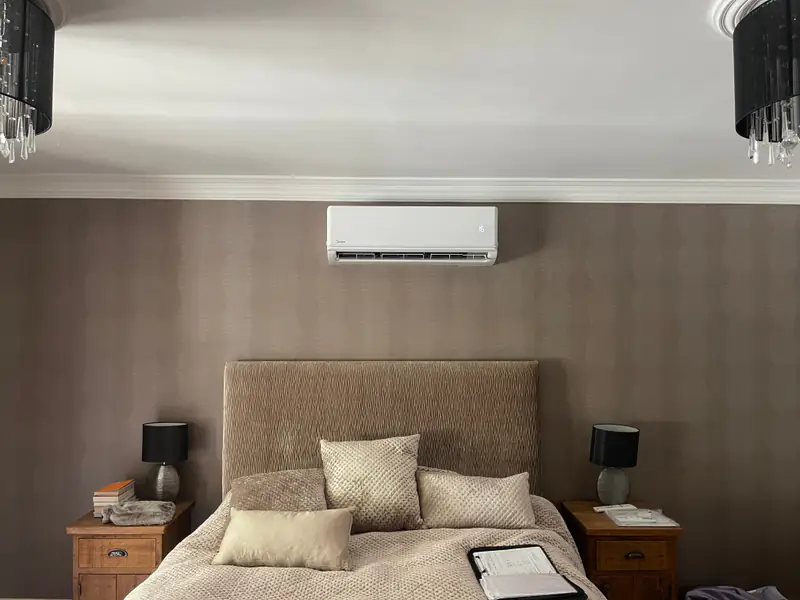
Sleep, body temperature and the right room setting
Most people sleep better in a room that feels cool rather than warm. As we fall asleep our core body temperature naturally drops a little, and a warm, humid room makes that harder, which is why hot nights so often mean tossing and turning, kicking off the duvet and waking early.
There isn’t one perfect number for everyone. Bedding, nightwear, age and personal preference all play a part, and partners often disagree. What you’re after is a room that’s comfortably cool at bedtime and stays that way, with no big swings and no cold blasts. Air conditioning does that well, as long as it’s the right size and set up for sleeping.
Comfortable, not cold
Don’t set it really low. A moderate setting, reached gently before bed and held through the night, is usually more comfortable, quieter and cheaper to run than blasting the room with cold air and then switching it off.
How loud is a bedroom air conditioner?
A well-chosen, properly installed bedroom unit on its lowest fan speed is very quiet, often described as a soft whisper or the sound of gentle airflow. Indoor units on a split system contain only a fan; the compressor, which is the noisy part, sits in the outdoor unit outside. That’s the main reason a split system is so much quieter than a portable.
Understanding dB(A) figures
- dB(A)
- Decibels with an A-weighting applied, which adjusts the measurement to reflect how sensitive human hearing is to different frequencies. It’s the figure most often quoted for air conditioning noise.
- Logarithmic scale
- Decibels don’t add up in a straight line. An increase of around 10 dB is generally perceived as roughly twice as loud, so a few decibels’ difference between models is noticeable.
- Sound pressure vs sound power
- Data sheets may quote sound pressure (what you hear at a set distance from the unit) or sound power (the total noise the unit emits). Compare like with like.
- Lowest fan speed
- Quiet or sleep settings run the indoor fan at its lowest speed. Many good wall-mounted units are quoted in the low-to-mid 20s dB(A) at this setting, but check each model’s figures.
Sleep and quiet modes
Most modern units have a sleep or night mode. Typically it lowers the fan speed, dims or turns off the display lights and gradually relaxes the set temperature over the first few hours so the unit isn’t working hard while you sleep. A separate quiet mode may also limit how hard the outdoor unit runs. Turning off the beeps and indicator lights is often possible too, which light sleepers appreciate.
Keeping outdoor unit noise away from bedrooms
The outdoor unit is far quieter than it once was, but it still makes a low hum and fan noise when it’s working. We position it away from your bedroom windows and your neighbours’ windows where possible, on anti-vibration mounts, and avoid corners and enclosed spaces that reflect sound. A well-sited unit should be barely noticeable from inside the house.
Where to put the indoor unit in a bedroom
The best position for a bedroom unit is usually high on a wall where air can travel across the ceiling and settle gently into the room, not pointing straight at the bed. Cool air is heavier than warm air, so a unit throwing air along the ceiling lets it fall and mix naturally. Air blowing directly onto your face or shoulders is uncomfortable however quiet the unit is.
Practical positioning rules
- Avoid mounting the unit directly above the headboard or aimed at the pillows.
- Allow the manufacturer’s clearances above and to the sides of the unit so it can breathe.
- Keep it clear of curtains, wardrobes and shelves that block airflow.
- Use the louvre settings to direct air along the ceiling or away from the bed.
- Think about where the pipework will run outside and how the condensate will drain.
- Make sure the filters can be reached easily for cleaning.
Rearranging the room
Sometimes the ideal wall for the unit is the one behind the bed, or the only external wall is opposite it. In that case we’ll talk through options: a slightly offset position, a unit on an internal wall with a longer pipe run, or a floor-standing console. Larger rooms may benefit from a unit with wider airflow control so the air can be directed more precisely.
Loft conversions and rooms under the roof
Loft conversions are the bedrooms most likely to need air conditioning, because they sit directly under a roof that absorbs the sun’s heat all day. Roof windows add to the problem, letting in strong sunshine from above. Even a well-insulated loft can stay warm well into the night. Plenty of lofts double as a study too, and the same unit that cools the room at night can keep a home office bearable on a hot afternoon.
Limited wall space and sloping ceilings
Sloping ceilings often leave little high, flat wall to mount a standard unit. Common solutions include mounting on a gable wall, using the knee wall or dormer face, or fitting a low-level console unit that sits near the floor. Consoles work well in lofts because they don’t need high wall space and can blow air both up and out.
Pipe routes in loft rooms
Pipework may run through the eaves storage space, down an outside wall or through a gable. We look for routes that keep pipes hidden and avoid cutting into insulation more than necessary.
Top-floor bedrooms in older homes
In the Victorian and Edwardian terraces you find all over York, the top-floor rooms are usually smaller with thick solid walls. A compact wall-mounted unit normally fits well, though core drilling through solid brick or stone needs care, and in conservation areas the external pipework and outdoor unit position deserve extra thought.
Nurseries and children’s bedrooms
Air conditioning can help keep a nursery or child’s bedroom at a steady, comfortable temperature, but it should be set and positioned with a little more care than an adult’s room. Follow current safe-sleep guidance from sources such as the NHS and The Lullaby Trust, which recommend keeping a baby’s room at around 16 to 20°C, and use a room thermometer rather than relying only on the unit’s display.
Sensible safety habits
- Choose sensible, moderate set temperatures rather than cooling the room hard.
- Position the cot or bed out of the direct airflow, and never directly beneath the unit.
- Keep remote controls out of reach, and use a child lock where the remote has one.
- Fit pipe covers neatly and make sure no cables or controls are within a child’s reach.
- Keep filters clean so the air stays fresh, and have the unit serviced regularly.
Children’s rooms often change as children grow, so it’s worth choosing a unit position that will still work when the cot becomes a bed or a desk moves in.
Cooling several bedrooms from one outdoor unit
A multi-split system connects two or more indoor units to a single outdoor unit, so several bedrooms can each have their own unit and their own control. It makes sense when the whole top floor overheats: one outdoor unit on the wall instead of three, and each person sets their own room.
Does one outdoor unit for several bedrooms save money?
A multi-split is not automatically cheaper than separate systems; it depends on the house. It saves on outdoor units, wall space and outside clutter, but pipe runs to each room can be longer, and if the single outdoor unit fails, every room is affected. Separate single splits can be more efficient when only one room is used at a time. We’ll price both during the survey, and our installation page goes into how each one is fitted.
| Consideration | Multi-split | Separate single splits |
|---|---|---|
| Outdoor units | One | One per room |
| Independent room control | Yes | Yes |
| If an outdoor unit fails | All connected rooms affected | Only that room affected |
| Efficiency with one room running | Can be slightly lower | Usually good |
| Appearance outside | Tidier | Several units to position |
Portable air conditioner or fixed split system?
For a bedroom used every night, a fixed split system is quieter, more efficient and more effective than a portable unit. Portables have their place as a stop-gap, but they’re a poor match for a room where you want to sleep.
| Portable air conditioner | Fixed split system | |
|---|---|---|
| Noise in the room | Compressor and fan in the room, often loud | Only a fan indoors; compressor outside |
| Window hose | Hot-air hose through a window that must stay ajar | None; a small hole carries the pipework |
| Efficiency | Lower; single-hose units also draw warm air in from outside | Much higher, shown by SEER and SCOP ratings |
| Heating | Limited or none on many models | Efficient reverse-cycle heating |
| Moisture | Water tank to empty or extra hose | Drained automatically |
| Floor space | Takes up floor space | Wall-mounted, out of the way |
| Installation | None | Professional installation required |
If you’re weighing it up, think about how many nights a year the room is too warm. If it’s a handful, a portable may do. If the room is uncomfortable for weeks every summer, a properly installed split system is the better long-term answer. Our air conditioning installation page explains the system types in more detail.
More than cooling: dehumidifying, winter warmth and overnight running
Dehumidifying muggy nights
Air conditioning removes moisture as it cools, so the room feels fresher rather than clammy. Most units also have a dry mode that focuses on removing humidity with less cooling, which is useful on close, muggy nights when the temperature isn’t especially high.
Heating the bedroom in winter
Most bedroom units are reverse-cycle heat pumps, so the same unit can warm the room efficiently in winter. That’s especially handy in loft rooms that are cold in winter and hot in summer, or bedrooms where the radiator is small or badly placed. A timer can take the chill off before you get up.
What does it cost to run overnight?
Running costs overnight are usually modest, because once the room is at temperature the unit only needs to remove the heat that keeps creeping in. As an illustration, a bedroom unit averaging 0.4 kW over eight hours at 25p per kWh would use 3.2 kWh, which comes to about 80p a night. Your figure will depend on the room, the weather, the unit’s efficiency and your own tariff.
Ways to keep costs down
- Close blinds or curtains during the hottest part of the day.
- Pre-cool the room gently with a timer rather than running it hard at bedtime.
- Keep the bedroom door closed while the unit is running.
- Choose a moderate set temperature and use sleep mode.
- Clean the filters regularly.
From survey to your first cool night
Look at the room
We check the room’s size, orientation, insulation, windows and roof, and where the bed and furniture sit, so the unit can be positioned for gentle, even airflow.
Plan the outside
We agree an outdoor unit position that considers noise for you and your neighbours, appearance and access for servicing, plus the pipe and condensate route.
Written quote
You receive a clear quote, with options if more than one bedroom is involved, so you can compare a multi-split with separate systems.
Installation day
A single wall-mounted system is usually fitted in a day. We protect floors and furniture, keep pipework neat and tidy up afterwards.
Set up for sleep
We test the system in cooling and heating modes and show you how to use sleep mode, timers, quiet settings and louvre directions.
What affects the price of bedroom air conditioning
The main cost factors are the number of bedrooms, the capacity needed, the type of indoor unit, the length and route of the pipe run, how hard the walls are to drill, how the outdoor unit is mounted, whether a new electrical circuit is needed and how the condensate will drain. Access matters too: a second-floor outdoor unit position may need scaffolding or a tower. A good quote spells out each of these, along with commissioning and what’s needed to make good.
Aftercare
Clean the filters every few weeks during heavy use, and book an annual air conditioning service to keep the unit quiet, efficient and hygienic. If something changes, such as new noises, water leaks or weaker cooling, our air conditioning repairs team can take a look.
We fit bedroom air conditioning across York and nearby areas including Haxby, Acomb and Copmanthorpe. Thinking about the conservatory as well? See conservatory air conditioning. Call 0191 743 9144 or contact us for a free, no-obligation quote.