
Making Haxby loft bedrooms bearable in summer
Haxby is a large village just north of York, adjoining Wigginton, with a wide range of family homes: older properties near the village centre, plenty of detached and semi-detached houses, and bungalows. Over the years, many of these have gained loft conversions, and those top-floor bedrooms are often the first rooms in the house to become uncomfortable in summer.
Heat soaks into the roof all day and radiates into the room long after sunset. Dormers and roof windows add direct sun. By bedtime the room can be several degrees warmer than the rest of the house.
Where the indoor unit goes in a loft
Sloping ceilings limit wall space, so we look for a full-height wall, usually a gable end or the wall opposite the dormer, and position the unit to blow along the room rather than onto the bed.
Dormers and roof windows
A dormer usually gives a short, straightforward route outside. Roof windows add solar gain, so we include them in the sizing; blinds on them help the system too.
Getting pipework down to the outdoor unit
Pipework from a loft often runs down the outside wall in a neat cover, or internally through a cupboard or eaves space, to an outdoor unit on the side or rear wall. A gable wall usually gives the shortest run.
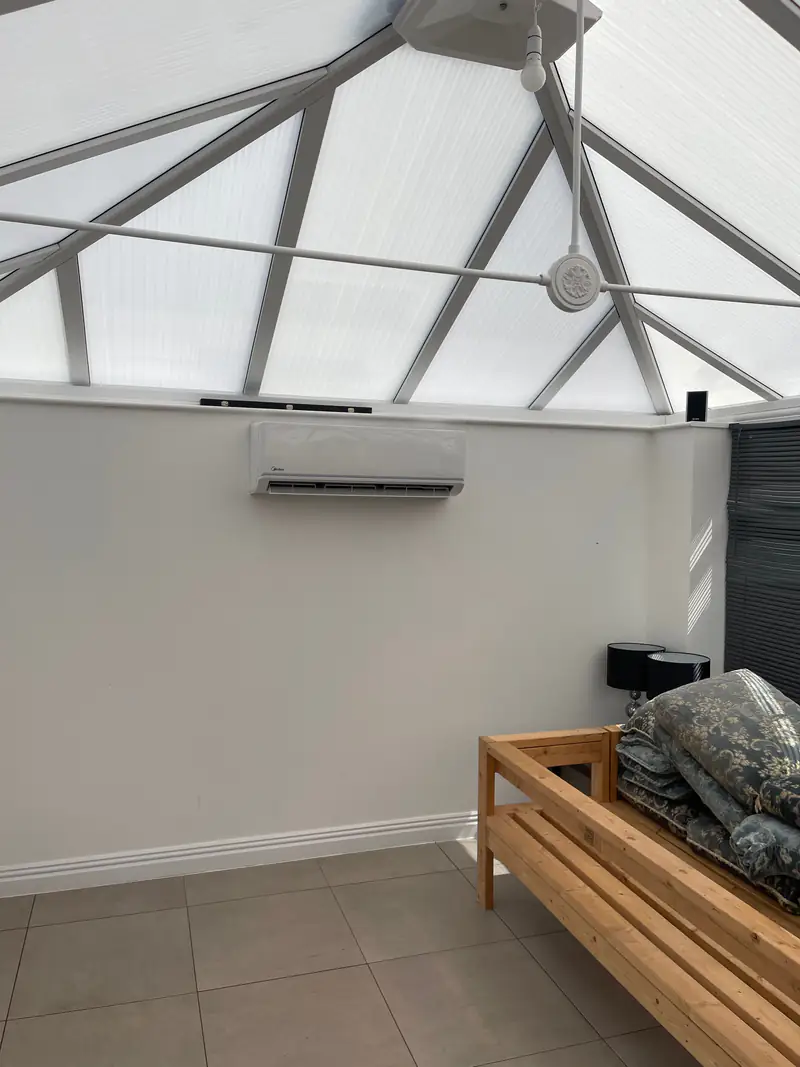
Conservatories that are too hot in July and too cold in January
Conservatories on Haxby’s family homes are often the brightest room in the house and the least usable. Glass heats up rapidly in sun and loses heat quickly on winter evenings, so the room swings between extremes.
Sizing for glass and orientation
Capacity is based on the area of glazing, the roof type, orientation and how the room is used. A south or west-facing conservatory needs considerably more cooling than an east-facing one of the same size.
Glass roofs versus solid or polycarbonate roofs
Older polycarbonate roofs offer little insulation, while solid replacement roofs reduce solar gain and heat loss considerably. If you are planning a roof replacement, it is worth doing that first and sizing the air conditioning afterwards.
Where can the indoor unit go if most walls are glass?
Usually on the original house wall that the conservatory is built against, which is solid, gives a short route for pipework and lets the unit blow out across the room. Where that wall isn’t available, a compact floor-standing unit on the dwarf wall is an alternative. Fixing to the glazing frames themselves is not suitable.
Heating as well as cooling
Because split systems are reverse-cycle heat pumps, the same unit can make a conservatory usable on cold days too. Our conservatory air conditioning page explains the options.
Is air conditioning noisy in a quiet village street?
Not if it is chosen and sited carefully, but in a quiet residential street at night, noise matters more than in the city. Background noise in Haxby is lower than near a main road, so an outdoor unit is easier to notice.
- Choose an outdoor unit with a low published sound level and a night mode
- Keep it away from neighbours’ bedroom windows and patios
- Avoid narrow side passages and corners that reflect sound
- Mount on anti-vibration feet or brackets on a solid wall
- Have a word with neighbours before installation
Bungalows and low outdoor units
Haxby has a good number of bungalows, where the outdoor unit inevitably sits close to ground level and close to bedroom windows, sometimes your own. On these homes we pay particular attention to which side of the house the unit faces and how far it is from the nearest bedroom on either side of the boundary.
Indoor noise at night
Indoor units are designed to be quiet, and in quiet or sleep mode the fan slows to a gentle hush. Most people are too relieved the room isn’t stuffy to notice it. Choosing a unit with a low published indoor sound level is still worthwhile for children’s bedrooms.
Permitted development for domestic heat pumps comes with conditions that include siting and noise. City of York Council is the planning authority for Haxby, and it is worth asking them if you are unsure.
One room or several? Planning for a family house
Families often start with one room and want more later. If that sounds likely, mention it at the installation survey. Planning for it now saves you a wall cluttered with outdoor units.
| Situation | Typical approach | Why |
|---|---|---|
| One hot loft bedroom | Single wall-mounted split | Simple, quick to fit and fully independent |
| Two or three bedrooms on one side | Multi-split with one outdoor unit | Less clutter outside, separate controls in each room |
| Conservatory plus bedroom | Two single splits | Rooms are often on different elevations with different loads |
| Home office | Compact wall-mounted split | Cools computer heat and gives efficient winter heating |
See domestic air conditioning for more on whole-home options, and bedroom air conditioning for quiet units suited to children’s rooms.
Cafés, salons and shops in Haxby village centre
Haxby’s village centre has a good mix of shops, cafés, hairdressers and other services. Small premises fill up quickly, and with the equipment running they can get warm on a mild day.
Hair and beauty salons
Dryers and styling tools add steady heat. Units are positioned so airflow doesn’t disturb clients or treatments.
Cafés
Coffee machines, ovens and customers push temperatures up. Filters need cleaning more often where there is cooking.
Shops
Lighting, fridges and glazed frontages add heat. Outdoor units are best kept to the rear.
Many village-centre premises have flats or offices above and neighbours on both sides, so the outdoor unit usually belongs at the rear, at a height and position that keeps it away from upstairs windows. Some commercial installations need planning permission, which we’ll point out at the survey. It’s much the same picture for shops in Huntington, just down the road.
Our commercial air conditioning installations are planned around opening hours wherever possible, to keep disruption low.
Heating with a split system when radiators struggle
Extensions, conservatories and loft rooms are often the coldest rooms in winter, because the original heating system was never sized for them. A reverse-cycle split system can heat them efficiently without extending the central heating.
- SCOP
- Seasonal coefficient of performance: heating efficiency over a typical season. Higher means more heat per unit of electricity.
- SEER
- Seasonal energy efficiency ratio: the equivalent measure for cooling.
- Defrost cycle
- In cold, damp weather the outdoor unit periodically defrosts itself. Heating pauses briefly; this is normal.
- Set temperature
- Each degree warmer in winter or cooler in summer increases running costs, so moderate settings are more efficient.
Getting the most from the controls
- Use heat mode at a moderate setting rather than turning it up high to warm the room faster
- Use the timer to bring a conservatory up to temperature before you use it
- Keep doors to unheated parts of the house closed while the unit runs
- Rinse filters regularly; a clogged filter reduces both heating and cooling output
As an illustration, a unit drawing 0.8 kW for five hours at 25p per kWh would cost about £1 a day; check your own tariff and usage.
Getting a quote in Haxby and Wigginton
Get in touch
Call 0191 743 9144 or use the contact page to tell us about the rooms you want to cool or heat.
Free survey
We visit, measure the rooms, check glazing, orientation and electrics, and agree positions with you.
Written quote
A clear written quote sets out the equipment, positions, pipe routes and any electrical work.
Installation
A single wall-mounted system is usually fitted in a day. We protect your home and tidy up afterwards.
Aftercare
We explain the controls and recommend an annual service to keep the system efficient.
We also cover nearby Strensall, Huntington and the rest of York.