
Strensall homes and how they handle a hot spell
Strensall is a village north-east of York, ringed by farmland and close to the open heathland of Strensall Common. It has grown in stages. Older cottages and terraces sit near the village centre, with post-war semis, bungalows and newer estates further out. The village also has long-standing military connections, which means a fair number of households arrive, settle and adapt houses to the way they live.
That variety shows up in how homes cope with warm weather. Older solid-walled properties tend to stay cool for the first few days of a heatwave, then hold the heat once the masonry has warmed through. Newer, well-insulated houses warm up quickly when the sun is on large windows and can be slow to shed it overnight. Either way, it’s usually the same few rooms that suffer.
Top-floor bedrooms
Rooms under the roof, especially in dormer bungalows and loft conversions, collect heat all afternoon and stay warm well past bedtime.
Home offices
A small spare room with a laptop, monitors and the door shut for calls can get noticeably warmer than the rest of the house.
Rear extensions
Single-storey extensions with roof lights or wide glazed doors gain heat quickly on south- and west-facing plots.
Conservatories
Glazed rooms swing from too hot in July to too cold in January, so a system that heats as well as cools earns its place.
Because modern split systems are reverse-cycle heat pumps, a unit fitted to fix a summer problem can also warm the same room efficiently in spring and autumn. That’s often what tips it for Strensall households. A home office or extension you can use all year is worth a lot more than one that’s bearable for a few weeks in July. Our domestic air conditioning page explains the main system types in more depth.
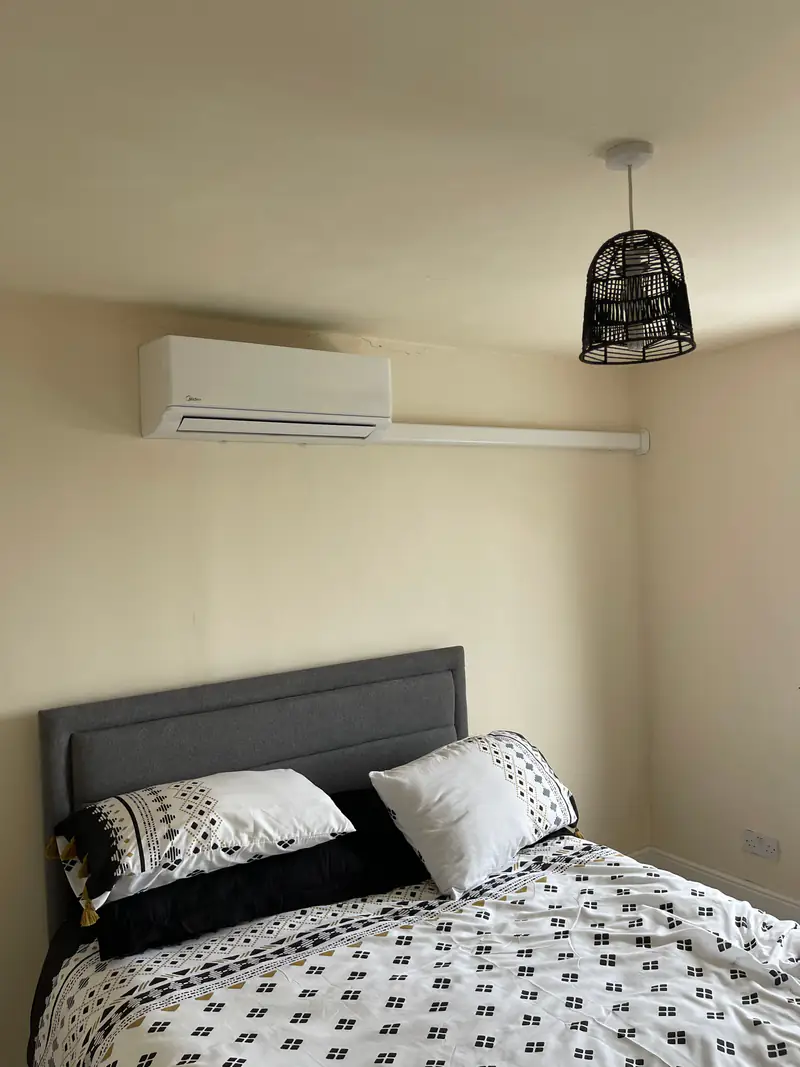
Keeping an outdoor unit quiet near the Common
In a quiet village, the outdoor unit’s position matters more than its specification sheet. Background noise around Strensall is low, particularly in the evening, so a fan and compressor that would go unnoticed beside a busy York road can be heard across a garden here. Put in the right place, it’s a low hum that you and the neighbours soon stop hearing.
Distance and line of sight
Sound drops off with distance and is blocked by solid objects, so we look for a position that puts the house itself between the unit and the nearest neighbouring bedroom window. A side return, a rear wall away from the boundary or a corner tucked behind a garage often works well. We avoid placing units directly below your own bedroom windows, too.
Mounting the unit properly
Most domestic outdoor units go on a ground stand or a wall bracket. Each has trade-offs, and the right choice depends on the wall and the space.
Ground-mounted on a stand
A ground stand on a level base keeps vibration away from the building structure, which helps in timber-framed or lightweight extensions. It needs a little clear space around it for airflow and should sit above any ground that collects water.
Wall brackets with anti-vibration mounts
A wall bracket keeps the unit off the lawn and away from children and pets. Rubber anti-vibration mounts between the bracket and the unit stop hum from transferring into the wall, which is worth having on any solid-walled house.
Can it run more quietly at night?
Yes: many units have a quiet or night mode that limits fan and compressor speed. If you mainly want a bedroom cooled overnight, we’ll show you how to use it so the system runs softly after dark.
Is my electrical supply good enough for air conditioning?
In most Strensall homes the supply is fine, but the consumer unit and wiring are the part of the survey that most often changes the plan in older properties. A single wall-mounted system draws a modest current, yet it usually needs its own dedicated circuit and a local isolator next to the outdoor unit, and that work must comply with the Wiring Regulations.
Houses that haven’t been rewired for a long time can have an older consumer unit with no spare ways, or wiring that isn’t suited to adding a new circuit. Neither is a reason not to install, but it can add electrical work to the quote. During the survey we’ll look at:
- Whether the consumer unit has a spare way and suitable protection for a new circuit
- The cable route from the consumer unit to the outdoor unit position
- Where a weatherproof isolator can be fitted so the unit can be switched off safely for servicing
- Whether an outbuilding or garden room has its own supply and how it is protected
- Any signs that earlier alterations need checking before new work is added
Good to know
If extra electrical work is needed, we’ll explain what it is and why before you agree to anything, and it will be listed separately on your written quote.
Split system or portable unit: a straight comparison
Plenty of people try a portable air conditioner first. They have a place, but in a quiet house they tend to disappoint. Here’s how the two compare in practice.
| Factor | Wall-mounted split | Portable unit |
|---|---|---|
| Noise in the room | Low; the compressor is outside | Higher; the compressor is in the room with you |
| Cooling performance | Sized to the room and steady on hot days | Often struggles in warm rooms, partly because the hot exhaust hose leaks heat back in |
| Heating | Efficient heat pump heating | Usually none, or basic electric heat |
| Window | Stays closed and secure | Needs to be part-open for the hose |
| Installation | Professional install with refrigerant pipework | Plug in and go |
| Best for | Rooms you use every day, all year | Occasional, short-term relief |
For a bedroom or home office in daily use, a properly sized split system is usually the better long-term answer. Our bedroom air conditioning page covers quiet indoor units and sleep settings, and if it’s a glazed room you’re trying to fix, read the conservatory air conditioning page.
What happens during a Strensall installation
A single wall-mounted system is usually fitted in a day. Multi-room systems or jobs with extra electrical work can take longer, and we’ll tell you what to expect when we quote. If you’d like to talk it over before booking a survey, send us a message.
Survey and written quote
We look at the room, its windows and orientation, where the outdoor unit could go, the pipe route and the electrics, then send a clear written quote.
Agreeing positions
Before any drilling, we confirm with you exactly where the indoor unit, the wall hole, the pipework and the outdoor unit will go.
Fitting the units
The indoor unit is mounted, a core hole is drilled, and the refrigerant pipes, cable and condensate drain are run neatly to the outdoor unit.
Electrical connection
The system is connected to its circuit with a local isolator, in line with the Wiring Regulations.
Testing and handover
The system is pressure-tested, evacuated and commissioned, then we show you the controls, timers and quiet mode and leave the area tidy.
Whoever installs your system should hold the appropriate F-Gas certification for work on refrigerant circuits, and it’s reasonable to ask to see it. For a fuller picture of the process, see our air conditioning installation page.
Shaping the cost of your quote
Every quote is based on the survey, so the clearest way to understand the price is to know what moves it. These are the factors that make the biggest difference in a village home.
- Capacity and system type
- A small single-room system costs less than a larger unit or a multi-split serving several rooms from one outdoor unit.
- Pipe run length
- Short, direct runs are simplest. Longer runs, or routes around corners and over extensions, take more materials and time.
- Wall construction
- Drilling through cavity brick is straightforward; thick solid walls or render need more care.
- Access and height
- An indoor unit on an upper floor with the outdoor unit at ground level is common, but awkward access can add time.
- Electrical work
- A new circuit is often needed; a consumer unit upgrade, if required, adds more.
- Condensate route
- Gravity drainage to a gully is simplest; where that isn’t possible a small condensate pump is fitted.
- Making good
- Trunking, sealing and tidying around the wall penetration are part of a neat finish.
How running costs work
Running costs depend on how hard the unit works and what you pay for electricity. As an illustration only: a unit drawing 0.7 kW for six hours at 25p per kWh would use about 4.2 kWh, roughly £1.05 a day. Check your own tariff, and remember an inverter system draws much less once the room is at temperature. Higher SEER and SCOP ratings mean lower running costs for the same comfort.
Looking after an existing system in Strensall
If you already have air conditioning, regular care keeps it efficient and quiet. Most home systems benefit from an annual service, and we’re happy to look at systems we didn’t install.
What a service covers
- Cleaning or replacing filters
- Cleaning the indoor coil and fan, and the outdoor coil
- Checking the condensate drain runs freely
- Checking electrical connections
- Checking operating pressures and temperatures
- Testing the controls and modes
Find out more on our air conditioning servicing page.
When does a system need a repair rather than a service?
It needs a repair when something has changed, not just when it needs a clean. Weak cooling, water dripping from the indoor unit, ice on pipework, new rattles or a flashing error code are all worth reporting. We’ll diagnose the fault and explain the options before doing any work. See air conditioning repairs for common faults. We also cover neighbouring Haxby and Huntington.