
Garden offices, studios and workshops
Dunnington is a village a short drive east of York, and like many villages within easy reach of the city it has a good number of people working from home or running a business from the garden. Insulated garden rooms, converted garages, timber studios and workshops are common, and they all have the same problem. Without help, they’re only comfortable for a few months of the year.
A small air-to-air split system is often the neatest answer, because it heats efficiently in winter and cools in summer from one indoor unit. How well it works depends on the building it goes into, and each type behaves a bit differently.
Insulated garden rooms
Purpose-built garden rooms with insulated walls, floor and roof are the easiest outbuildings to condition. Heat loss is low, so a modest unit usually copes in both seasons.
Watch for
Large glazed doors on the sunny side. Glass gains heat fast, so a room with a wall of glazing may need more cooling capacity than its floor area suggests.
Converted garages
A garage turned into an office or gym usually has solid walls and, unless it has been upgraded, a thinly insulated roof and floor. These spaces feel cold in winter and warm up under the roof in summer.
Watch for
An uninsulated up-and-over door or a single-skin wall. Improving insulation first can mean a smaller, cheaper system that runs for less.
Workshops and studios with equipment
Kilns, computers, printers, compressors and lighting all add heat. A pottery studio or a workshop full of machinery may need more cooling than an office of the same size, and dust means filters need cleaning more often.
Why Dunnington home businesses look at heat pumps
For a business run from home, an uncomfortable workspace is lost time. A reverse-cycle split system tackles both ends of the year, and it does so efficiently: for every unit of electricity it uses, a heat pump typically delivers several units of heat into the room, which is why it often compares well with plug-in electric heaters.
Steady temperature
An inverter system holds a set temperature rather than cycling hard on and off, so the room stays even through the working day.
Quiet for calls
The compressor sits outside, so the indoor unit is quiet enough for video calls and recordings.
Timers and schedules
Set the room to warm up before you start and switch off when you finish, so you only pay for the hours you use.
Clients and customers
If clients visit a treatment room, salon chair or studio, a comfortable space makes a better impression.
If your business has a small premises as well as a home base, our commercial air conditioning page covers larger rooms and multi-unit systems, and our office air conditioning page goes into sizing for desks, screens and meeting spaces.
Can a garden room run on its existing power feed?
Sometimes, but not always: it depends on how the outbuilding is supplied and what else runs from it. Many garden rooms are fed by an armoured cable from the house with a small consumer unit inside. If that supply was sized for lights, sockets and a heater, adding air conditioning may be fine; if it already carries a heavy load, it may need upgrading.
What the electrical check covers
Air conditioning usually needs its own protected circuit and a local isolator by the outdoor unit, and all work must comply with the Wiring Regulations. During the survey we check the existing feed, the protection at both ends and the load, and if anything needs changing we explain it and list it separately on the quote.
Where the condensate goes
In cooling mode the indoor unit produces water, which must drain away by gravity or through a small condensate pump. Outbuildings often have no internal drain, so the pipe usually runs outside to a soakaway, gully or water butt overflow. We’ll agree a route that won’t leave a damp patch by the door.
Planning the pipe route
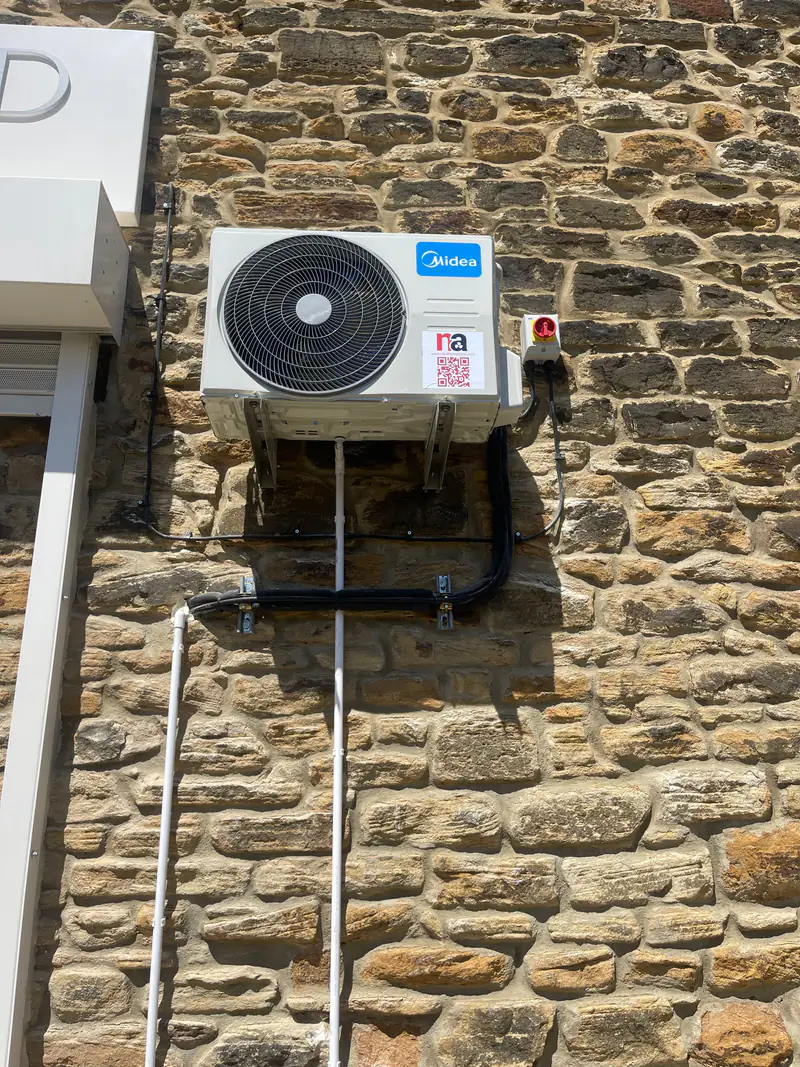
With an outbuilding, the outdoor unit can usually sit right beside it, so pipe runs are short and tidy. It’s often easier than fitting a unit in the main house.
Choosing between a wall unit, a floor console and a ceiling cassette
The indoor unit you choose shapes how the room looks and feels. Any of the types below can be paired with an outdoor unit sized for the space. If it’s a bedroom you’re cooling, our bedroom air conditioning page goes into the quietest options.
| Unit type | Where it suits | Things to know |
|---|---|---|
| Wall-mounted split | Most bedrooms, offices and garden rooms | Compact, quiet and usually the simplest to install |
| Floor console | Rooms with sloping ceilings or little high wall space, such as loft rooms and low garden buildings | Sits low like a radiator; good for heating as warm air rises naturally |
| Ceiling cassette | Larger rooms with a ceiling void, such as a big studio or open-plan space | Spreads air evenly in four directions; needs space above the ceiling |
| Multi-split | Two or more rooms served from one outdoor unit | Saves wall space outside; each room has its own control |
Traditional and newer houses in Dunnington
The main house matters too. Dunnington has a mix of traditional village properties and more recent homes, and they behave very differently in hot weather.
Older properties
Traditional homes may have thicker walls and smaller windows. They resist heat early in a warm spell but can stay warm once heated through. Pipe routes need planning because drilling through solid masonry is slower, and we agree hole positions with you before starting. If the property is listed or in a conservation area, consent may be needed; Dunnington is within the City of York Council area.
Newer homes
More recent houses tend to have open-plan living areas, bigger glazing and good insulation. They warm up quickly on sunny days, especially rooms with bifold doors. Cavity walls make installation straightforward, and there’s usually a choice of outdoor unit positions in the garden or side passage. The newer estates in Huntington are much the same.
Whichever you have, a domestic air conditioning system is sized to the room rather than the whole house, which keeps installation and running costs sensible.
A checklist before you book a survey
You don’t need to prepare anything. Still, if you can pass on a few details when you get in touch, we can give better advice and get the quote right first time.
- Which room or outbuilding you want to condition and roughly how big it is
- Which way its main windows or doors face
- Whether you mainly want cooling, heating or both
- What equipment runs in the space during the day
- Where the outbuilding gets its electricity from
- Any preference for where the outdoor unit should and shouldn’t go
- Whether the property is listed, in a conservation area or leasehold
Once we’ve visited, you’ll get a written quote setting out the system, the work involved and anything extra, such as electrical upgrades or a condensate pump. See our air conditioning installation page for what happens next.
Running costs worked through
What you pay to run a system depends on its efficiency, how many hours it runs and your electricity tariff. Efficiency is shown as SEER for cooling and SCOP for heating, and higher figures mean more output for the same electricity.
| Scenario | Average power draw | Hours | Illustrative cost at 25p per kWh |
|---|---|---|---|
| Garden office cooled on a warm afternoon | 0.6 kW | 5 | Illustration: about £0.75 |
| Garden office heated on a cold working day | 0.8 kW | 8 | Illustration: about £1.60 |
| Studio with equipment cooled all day | 1.0 kW | 8 | Illustration: about £2.00 |
These figures are for illustration only and real draw varies with the weather, insulation and settings.
How can I keep running costs down?
The biggest savings come from habits rather than hardware. Close doors and windows while the system runs, use timers so the room is only conditioned while you’re working, keep filters clean and avoid extreme set points: a cooling setting a few degrees below the outside temperature is usually comfortable. In an outbuilding, improving insulation and shading glazed doors reduces the load further.
Service visits, repairs and keeping records
A system in a dusty workshop or busy studio needs more attention than one in a spare bedroom. As a rule of thumb, home systems benefit from an annual service, and dusty environments from more frequent filter cleaning in between.
- Clean or replace filters and check the indoor coil and fan
- Clean the outdoor coil and clear leaves or debris from around it
- Check the condensate drain and any pump
- Check electrical connections and controls
- Check operating pressures and temperatures, and note the results
Keeping a simple record of each visit helps spot changes over time. Our air conditioning maintenance page explains planned visits, and if something has gone wrong, our air conditioning repairs page covers common faults. We also cover nearby Stamford Bridge and Pocklington.