
Do I need permission for an outdoor unit in Fulford’s conservation area?
You may, depending on where the unit goes and whether the building is listed. Fulford’s historic village core along Main Street is a conservation area, and an outdoor unit visible from the road can need planning permission from City of York Council. Units out of sight at the rear are often more straightforward, but always confirm with the council before committing.
Fulford sits on the southern edge of York along the A19, which runs as Fulford Road and then Main Street through the village. Around the older core there is a mix of Victorian and Edwardian houses, interwar homes, and more recent estates, so the planning picture varies from one street to the next.
Older houses along Main Street
Period properties here typically have solid brick walls, sash or casement windows and rear gardens or yards. The front elevation is what the conservation area protects most, so we design around it.
Discreet positions that often work
- Rear walls facing the garden rather than the street
- Low-level ground mounts screened by a garden wall or planting
- Side passages, where there is enough space for airflow and access
- Pipe covers painted to match the brickwork
Listed buildings
If your house is listed, internal work such as drilling through historic fabric can also need listed building consent. Check with City of York Council before any work is booked.
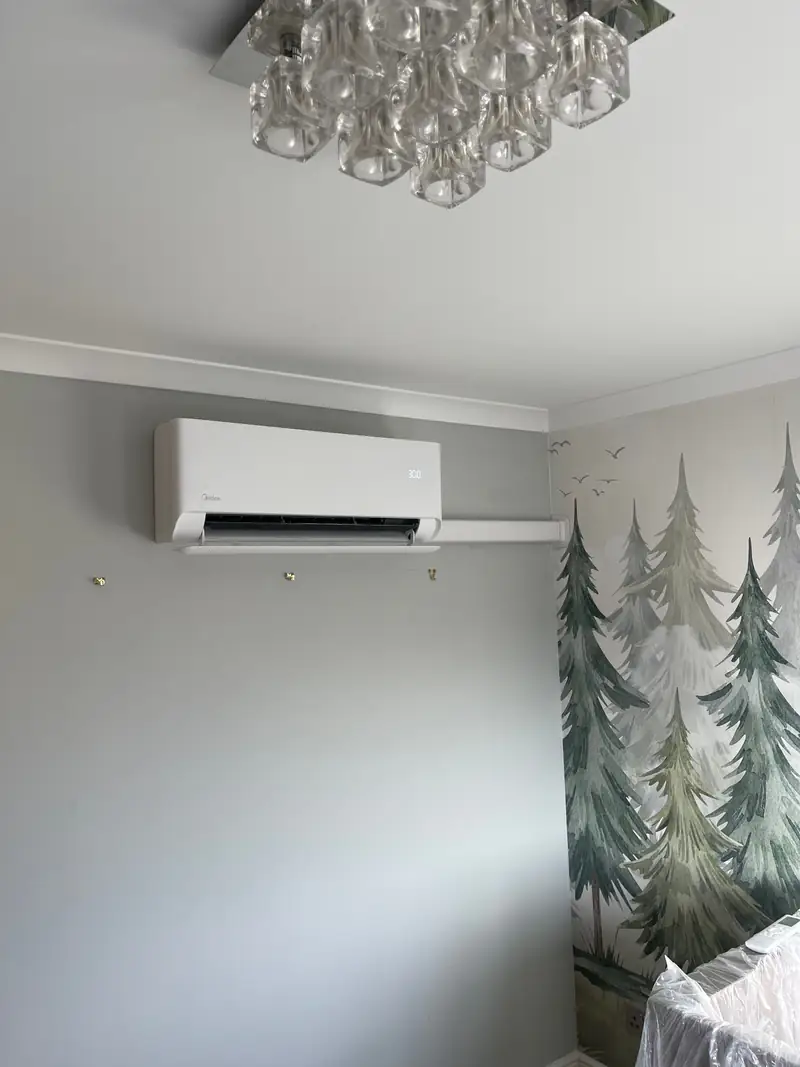
Home offices, studies and garden rooms
Plenty of Fulford households include someone who works from home, including academics and researchers from the nearby university. A spare bedroom with a south-facing window, two monitors and a laptop can get uncomfortable by mid-afternoon, and garden offices with lightweight walls heat up even faster.
Garden office electrics and pipe routes
A garden room needs a suitable electrical supply, and the air conditioner may need its own circuit and a local isolator. We check the existing supply, the distance from the house and the best route for refrigerant pipes, drain and cable, then put everything in the quote.
Keeping video calls quiet
Indoor units are quiet, but on a call you notice everything. Pick a unit with a quiet mode and put it where the air won’t blow across the desk or the microphone. Pre-cooling the room before a long meeting means the unit can then tick over quietly.
Is a portable air conditioner good enough for a study?
For occasional use it can help, but portable units are noisier, less efficient and need a hose out of a window, which lets warm air back in. If you work in the room every day, a fixed split system is the better buy. It’s quieter, it cools properly and it heats efficiently in winter.
Our domestic air conditioning page covers single-room systems in more detail.
Letting a house near the University of York
Fulford is close to the University of York’s Heslington campus, so the area includes shared houses and professional lets alongside family homes. Air conditioning is not a standard feature in lets, but a landlord may add it to a hot top-floor room or a converted loft that would otherwise be hard to rent in summer.
Shared houses and individual room control
In shared houses, a separate system per room avoids arguments over the thermostat. Simple remote controls and clear written instructions help tenants use the system efficiently.
Landlord records worth keeping
- Installation and commissioning paperwork
- Electrical certificate for any new circuit
- An annual service record
- Notes for tenants on cleaning filters and using the controls
Regular servicing keeps the system efficient between tenancies and gives you a record if anything is questioned.
Living by the A19: traffic, closed windows and cooler rooms
The A19 is a busy route into York, and homes close to it face a familiar summer trade-off: open the windows and let in traffic noise and fumes, or keep them shut and swelter. With a split system the street-facing windows can stay shut and the room still stays cool.
Front bedrooms on a main road
Front bedrooms facing the road are often the ones people most want to keep closed at night. The outdoor unit can usually go to the rear or side, with pipework routed through the house or along a side wall, so the front looks just as it did. Working out that route is most of the installation survey on a road like this.
Filters and air quality
Indoor units recirculate and filter room air rather than drawing it in from outside, so they don’t bring traffic fumes indoors. The washable filters catch dust and need rinsing every few weeks in heavy use; some units have optional finer filters. Clean filters keep it quieter, too. The coils and fan you can’t reach get done on a proper maintenance visit.
Low-lying ground near the Ouse
Parts of Fulford slope down towards the river and Fulford Ings, which floods in wet winters. On properties in a flood-risk area, an outdoor unit on raised wall brackets with electrical connections kept high is a sensible precaution. We do the same on riverside streets in Bishopthorpe, a little way downstream.
For bedrooms in particular, see bedroom air conditioning for advice on quiet units and sleep modes.
How efficient is a heat pump for heating a single room?
Very efficient, compared with direct electric heating. An air-to-air split system moves heat rather than generating it, so it delivers several units of heat for each unit of electricity, depending on conditions. That is why many people use their air conditioning for heating in spring and autumn.
- SEER
- Seasonal energy efficiency ratio: cooling efficiency across a typical season. Higher is better.
- SCOP
- Seasonal coefficient of performance: heating efficiency across a typical season. Higher is better.
- Capacity (kW)
- How much heat the unit can move. It should match the room’s heat loss and gain, not just its size.
- Inverter
- A compressor that varies its speed, so the unit runs steadily at lower power once the room is at temperature.
As an illustration, if a room needs 2 kW of heat and the system averages a performance of 3, it would draw about 0.67 kW. Over four hours at 25p per kWh, that is roughly 67p, compared with about £2 for a 2 kW direct electric heater in this illustrative example. Real figures depend on the weather, the room and your tariff.
Efficiency drops somewhat in very cold weather, and the outdoor unit periodically runs a short defrost cycle, but for rooms such as a home office, study or garden room, a split system is a practical, controllable source of heat that works independently of the central heating.
What a written quote for a Fulford home should cover
A good quote tells you exactly what you are getting and where it will go. If anything in the list below is missing, ask.
| Item | Why it matters |
|---|---|
| Equipment type and capacity | Shows the system has been sized for the room, not guessed |
| Indoor and outdoor unit positions | Confirms appearance, noise and any planning implications |
| Pipe route and length | Longer or concealed runs affect time and cost |
| Condensate drain method | Gravity drain or pump; affects noise and maintenance |
| Electrical work | Whether a dedicated circuit and isolator are included |
| Making good | Who fills, seals and tidies around holes and covers |
| Commissioning and handover | Testing, controls explained and paperwork provided |
What to ask before you book a Fulford installation
- Can I see your F-Gas certification? Anyone handling refrigerant must hold the appropriate certificate under UK rules.
- How did you work out the capacity for this room?
- Where exactly will the outdoor unit and pipe covers go, and what will they look like from the street?
- Is the electrical work included, and will I receive the certificate?
- What servicing do you recommend, and how often?
Costs depend on the system, number of rooms, pipe length, wall construction, access and electrical work. For a free survey and quote, call 0191 743 9144 or visit our contact page. We also cover Bishopthorpe, Dunnington and the rest of York.