
Two sides of Clifton: period streets and Clifton Moor
Clifton covers a long stretch of north York. Close to the city, around Clifton Green and the roads leading towards Bootham, there are streets of substantial Victorian and Edwardian houses, many now split into flats or let to professionals. Further out, the housing becomes more modern, and beyond that, near the outer ring road, Clifton Moor is a separate retail and business area of large shops, offices and trade units.
Homes nearer the centre
Older houses here have high ceilings, bay windows, solid brick walls and often a second floor or attic. York Hospital is close by, and many residents work shifts. That combination shapes most domestic enquiries: big rooms that warm up slowly but stay warm, and bedrooms that need to be cool during the day as well as at night.
Business premises at Clifton Moor
Clifton Moor’s offices, showrooms and retail units tend to be open-plan with suspended ceilings, large glazed frontages and plenty of electrical equipment. They call for a different approach, usually ceiling cassettes or ducted systems, sized for occupancy and equipment rather than floor area.
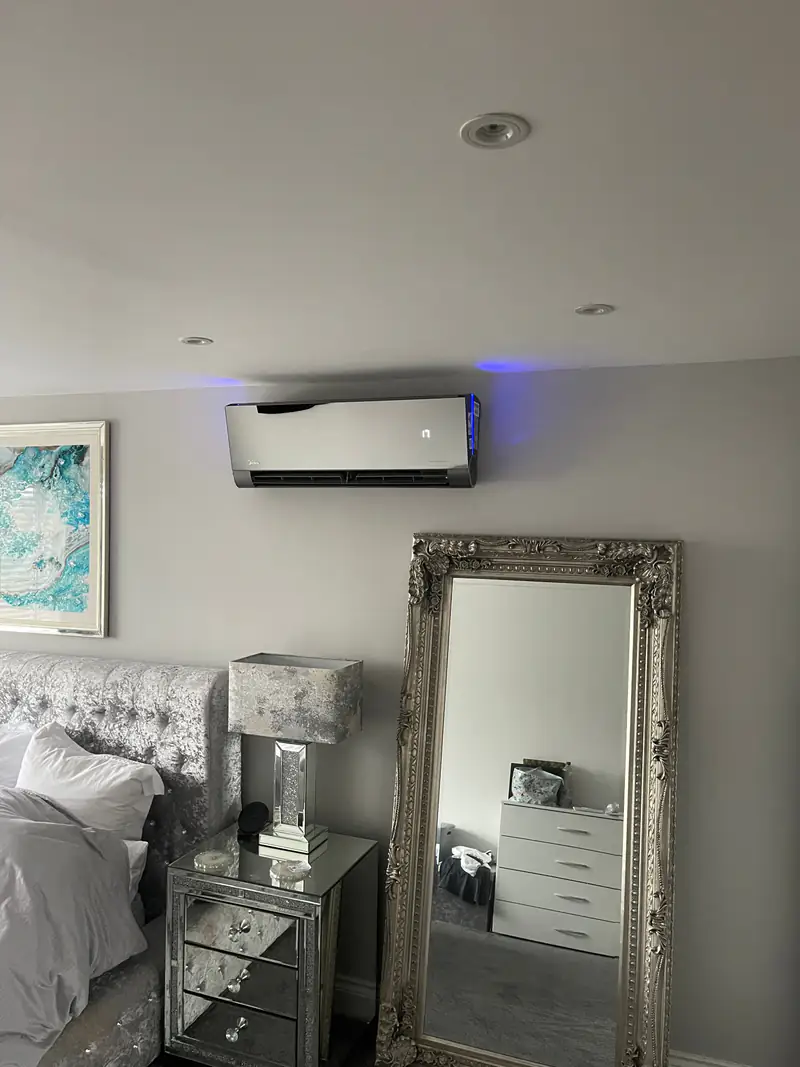
Tall ceilings, bays and second-floor rooms
A Victorian room with a three-metre ceiling holds far more air than a modern bedroom with the same floor area, and warm air collects at the top. That changes how a system should be sized and where the indoor unit should go.
Why high ceilings change the sizing
We calculate capacity on the room’s volume and real heat gains, including the bay glazing, the roof above a top-floor room and the people and equipment in it. Bigger isn’t better. An oversized unit cools the air quickly but cycles on and off too often, and the room ends up clammy.
Air throw and placement
In a deep room, the indoor unit should blow along the longest dimension so air reaches the far end. Mounting it too high on a tall wall can leave cool air stratified above head height; a sensible height, with louvres set correctly, gives even comfort.
Preserving original features
Cornicing, picture rails, ceiling roses and panelled doors are worth protecting. Pipework can often run behind a cupboard or along an external wall rather than across a decorated internal wall.
Sleeping through the day near York Hospital
For anyone working nights, a hot bedroom on a summer afternoon is more than a nuisance. Clifton has plenty of households where someone sleeps during the day, and upstairs rooms in brick terraces can hold heat well into the evening.
- Choose an indoor unit with a very low quiet-mode sound level
- Use a sleep mode that gradually eases the set temperature
- Position the unit so air flows across the room, not onto the bed
- Set a timer so the room is already cool before you get home
- Pair it with blackout blinds to cut solar gain through the window
Why daytime sleep is harder in summer
Bedrooms are at their warmest in the afternoon and early evening, exactly when a night-shift worker is trying to sleep. Opening a window brings in traffic and street noise, and a desk fan only moves warm air around. With a split system the window stays shut and the blinds stay down, and the room holds a steady temperature until you wake up.
Dehumidifying on muggy days
Most split systems also have a dry mode, which removes moisture without dropping the temperature too far. On humid days that alone can make a room feel noticeably more comfortable.
Heating for winter too
The same system runs as a heat pump in cold weather, which helps if your bedroom is on a cold north-facing elevation. See bedroom air conditioning for more on choosing quiet units.
Do I need freeholder consent to fit air con in a Clifton flat?
In most cases yes, if you own a leasehold flat. The external walls, roof and shared areas usually belong to the freeholder, and fixing an outdoor unit or drilling a pipe hole normally needs their written consent. Tenants need their landlord’s permission as well.
- Read the lease for clauses on alterations and external fixtures
- Ask the freeholder or managing agent for written consent
- Agree where the outdoor unit can sit: rear wall, flat roof or balcony
- Check whether neighbouring flats’ windows will be close by
- Confirm planning position with City of York Council if the building is in a conservation area
We can write up the proposed installation, with positions and pipe route, for you to send over. It saves a lot of back and forth.
Showrooms, offices and retail units at Clifton Moor
Commercial buildings around Clifton Moor have different needs from homes a mile or two south. Long opening hours, customer footfall, lighting and IT equipment create steady heat, and large glazed frontages add solar gain in the afternoon. The units at Monks Cross in Huntington behave in much the same way.
| System | Best suited to | Points to consider |
|---|---|---|
| Ceiling cassette | Open-plan offices and shop floors with suspended ceilings | Spreads air in several directions; needs ceiling void depth |
| Ducted unit | Showrooms and offices wanting only grilles on show | Needs good void space and access panels for maintenance |
| Wall-mounted split | Small offices, staff rooms and meeting rooms | Quick to install; simple to service |
| Multi-split | Several small rooms with limited outdoor space | One outdoor unit; each indoor unit controlled separately |
| Dedicated equipment-room cooling | Server and comms rooms | Sized for continuous running |
For more detail, see our office air conditioning and commercial air conditioning pages.
Is a ducted system worth it for an open-plan office?
It can be, if there is enough ceiling void and you want the cleanest look. A ducted unit sits hidden above the ceiling and delivers air through grilles, so the office shows nothing but neat vents. A cassette is usually simpler and quicker to fit. If you’re torn between the two, ask us to look at the ceiling and we’ll tell you what will actually fit.
Where ducted systems win
- Client-facing showrooms and reception areas where appearance matters
- Rooms where several grilles give more even distribution
- Spaces where noise from the indoor unit needs to be kept away from desks
Where a cassette makes more sense
- Shallow ceiling voids with little room for ductwork
- Fit-outs on a tight timescale
- Spaces that may be reconfigured, where a cassette can be moved more easily
Service intervals for homes and busy workplaces
How often a system needs attention depends on how hard it works and the air it handles. A bedroom unit used on warm nights needs far less than a cassette running ten hours a day in a busy shop.
- Homes and flats
- An annual service is usually enough: filters, coils, fan, drain, electrical checks and performance test.
- Offices
- Annual or twice-yearly, depending on running hours and occupancy. Filters may need rinsing between visits.
- Retail and showrooms
- Twice-yearly is common where doors are open often and dust is brought in.
- Server and equipment rooms
- Regular checks matter because a failure can affect equipment. Planned maintenance helps catch problems early.
Find out what a visit includes on our air conditioning servicing page.
Conservation areas north of the city centre
Some of the older streets between Clifton and the city walls fall within conservation areas, and individual buildings may be listed. An outdoor unit visible from the street, or work to a listed building, may need consent from City of York Council.
- Favour rear walls, yards and gardens over front elevations
- Keep pipe runs low and paint covers to match the wall where appropriate
- Avoid fixing to decorative brickwork or stone details
- Ask the council before booking if you’re unsure
Houses that have been converted to flats
Where a large period house has been split into several flats, external walls can fill up quickly with boiler flues, soil pipes and satellite dishes. It is worth agreeing a sensible location for outdoor units across the whole building, so that each flat that wants air conditioning later is not left with only the street elevation. Freeholders and managing agents often welcome a coordinated approach.
Riverside streets towards Clifton Ings
Some lower-lying streets nearer the Ouse sit close to land that floods. If your home is in a flood-risk area, mounting the outdoor unit on wall brackets well above ground and keeping electrical connections high is a sensible precaution.
If you’re further out, we also cover Haxby, Huntington and the rest of York. To arrange a survey, call 0191 743 9144 or use our contact page.