
Georgian frontages and the cobbled market place
Easingwold is a Georgian market town in the Vale of York, north of the city, laid out round a wide cobbled market place. The streets off it are lined with period town houses, cottages, shops and pubs, a lot of them brick with sash windows and frontages packed tight together. Newer housing has grown up round the edges.
So there are two quite different kinds of property to plan for, and what’s right for one is rarely right for the other.
What period construction means for air con
Older houses usually have solid brick walls, high ceilings, timber floors and sashes. Thick walls take a long time to warm up, so plenty of period rooms stay fairly cool for most of the summer. South-facing upper floors, attic rooms and glazed rear extensions are another matter.
Practical consequences
- Core drilling through solid brick takes more care and dust control than drilling a cavity wall
- Pipe routes go through cupboards, voids and rear walls, not across the front elevation
- High ceilings mean more room volume, which affects the capacity needed
- Cornicing, panelling and other original features decide where an indoor unit can sensibly go
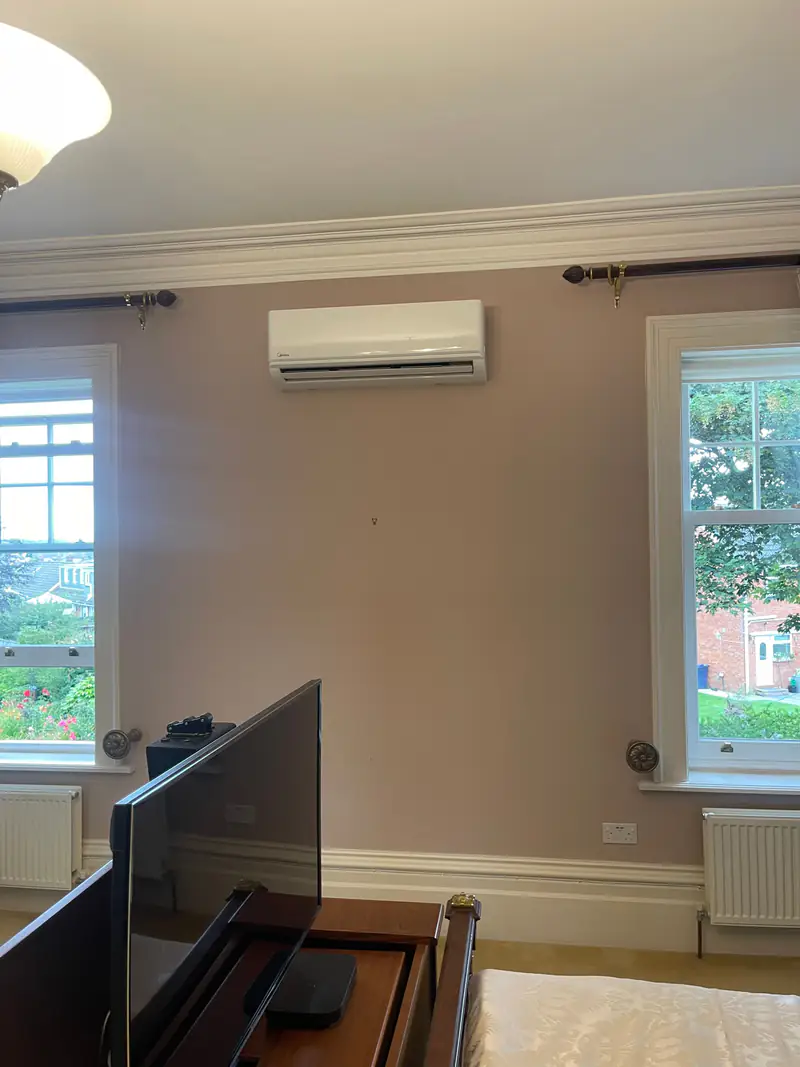
Is air conditioning suitable for a period house in Easingwold?
Yes, in most cases, as long as the system is planned around the building instead of forced onto it. Usually that means a slim wall-mounted indoor unit on an internal or rear wall, pipework run quietly through the back of the house, and the outdoor unit out of sight in a back yard or garden.
Georgian frontages and the market place conservation area
Some of Easingwold’s historic buildings are listed, and parts of the town may sit in a conservation area. Either can mean you need consent for external equipment or internal alterations. North Yorkshire Council is the planning authority. Check with them before settling on an outdoor unit position, particularly anywhere you can see from the market place or the street.
Check before you book
Not sure whether your property is listed or in a conservation area? Ask North Yorkshire Council’s planning team. We’ll also point out anything at the survey that looks like it may need consent.
When another approach is better
Now and then a room just isn’t a good candidate. There may be nowhere acceptable for the outdoor unit, or the pipe route would mean damaging original fabric. If so, we’ll tell you, and talk through other options, like treating a different room or putting the unit in a rear extension.
Hiding the outdoor unit
On a period street, the outdoor unit takes the most thought. It needs free airflow, a solid base or bracket, a sensible pipe run back to the indoor unit and somewhere for the condensate to go. And it mustn’t spoil a historic frontage or keep the neighbours awake.
| Position | Works well when | Things to watch |
|---|---|---|
| Rear yard, ground level | There’s a level paved area with access | Keep clear of bins, gates and neighbours’ windows |
| Rear wall bracket | Ground space is tight | Wall must be sound enough for fixings; vibration isolation |
| Flat roof of a rear extension | Roof is accessible and strong enough | Roof covering protection and safe service access |
| Side return or alley | A passage runs down the side | Airflow, access rights and noise reflection between walls |
| Garden, away from the house | Newer homes with larger plots | Longer pipe runs and how the pipes are protected |
Pipe run length, working at height and making good after drilling all affect the cost of an air conditioning installation, and your quote spells out each one.
Newer homes on the edge of town
The modern estates round Easingwold are mostly well insulated and fairly airtight. Great for winter heating bills, less so in a heatwave, when the warmth has nowhere to go. Upstairs bedrooms, loft conversions and rooms with big patio doors are the usual culprits.
Bedrooms that stay warm at night
A quiet indoor unit with a night or sleep mode brings the room down to a comfortable temperature without a fan droning away. Our bedroom air conditioning page explains more.
Conservatories and garden rooms
Glazed rooms swing from too hot to too cold. A reverse-cycle unit sized for the glazing makes them usable all year. See conservatory air conditioning.
Home offices
A spare room with a computer and the door shut overheats quickly. A small split system keeps the working day bearable.
Straightforward installs
Cavity walls, easy garden access and modern wiring usually make installs in newer homes quicker and simpler.
Heating as well as cooling: the heat pump case
Every air-to-air split system is a reverse-cycle heat pump, so the unit that cools in July heats in January too. Plenty of homes round here run on gas or oil, and a split system makes a handy extra heat source for one room. It’s also a way to warm a conservatory without firing up the whole central heating. Our page on air conditioning for homes compares the system types.
- SCOP
- Seasonal coefficient of performance for heating. Higher is better: a SCOP of 4 means roughly four units of heat for every unit of electricity across a season.
- SEER
- Seasonal energy efficiency ratio for cooling. Again, higher is better.
- Capacity (kW)
- The heating or cooling output. A high-ceilinged Georgian room needs more than a modern room with the same floor area.
Illustrative running cost
As an illustration, a unit drawing 0.6 kW for four hours at 25p per kWh would use 2.4 kWh, or about 60p. Check your own tariff. Real figures depend on the weather, the room and your settings.
Quiet nights in a small North Yorkshire town
Easingwold is quiet in the evenings, so the outdoor unit needs to be as well. Modern units run quietly, but where you put them still counts, especially on a terrace or where gardens back onto each other. It’s the same story in Strensall and the other villages north of York.
- Keep outdoor units away from neighbours’ bedroom windows
- Use anti-vibration feet or mounts on brackets
- Avoid tight corners where sound bounces between walls
- Choose indoor units with a low-noise night setting for bedrooms
- Keep the unit serviced: dirty coils and fans make systems work harder and louder
Choosing the indoor unit for a bedroom
Indoor units differ in how quiet they are on the lowest fan speed, so compare the published sound levels before choosing one for a bedroom. Position matters as well. Mounted above the door or on the wall opposite the bed, the unit spreads air across the room instead of straight at the pillow. A sleep mode that eases the set temperature up overnight stops you waking cold at four in the morning.
Shops and pubs around the market place
Businesses in the centre often share walls and yards with homes. Outdoor units for commercial air conditioning need the same care over noise as domestic ones, plus some thought about opening hours. If a unit runs into the evening, put it where it won’t bother people living above or next door.
Regular air conditioning servicing keeps units quiet and efficient, with the filters, coils, drains and controls checked each visit.
Surveys, quotes and planning checks for Easingwold
Every job starts with a visit to look at the rooms, the walls and where the outdoor unit could go. After that you get a written quote and a clear idea of what’s involved.
- Call 0191 743 9144 or get in touch through our contact page.
- We book a survey and look at room sizes, wall construction, glazing, electrics and outdoor unit positions.
- We point out any listed-building or conservation-area questions to check with North Yorkshire Council.
- You get a free, no-obligation written quote.
- Once you’re happy, we agree a date. A single wall-mounted system is usually fitted in a day.
What your quote should list
- Indoor and outdoor unit capacities and efficiency ratings
- Pipe run length and route
- Electrical work, including any dedicated circuit and isolator
- Condensate route, by gravity or with a pump
- Access needs and any making good after drilling
We also cover Haxby and the towns and villages nearby. The full list is on our areas we cover page.