
Cooling a Wharfe-side market town
Wetherby is a market town on the River Wharfe in West Yorkshire, just off the A1(M), and plenty of people know it for the racecourse. The centre is full of independent shops, cafés, salons and small offices, many in older buildings. Round that, it’s mostly settled family housing, with no shortage of extensions and conservatories.
That mix decides how we design a system here. A salon on the main street, an accountant’s office over a shop and a 1990s detached house with a south-facing garden room all get too hot for different reasons. Each needs its own answer on unit type, capacity and where the outdoor unit can sensibly sit.
The town centre
Premises in the centre tend to be deep and narrow, with poor rear access and neighbours either side. So the pipe route, condensate drainage and outdoor unit position matter as much as the indoor unit. A flat roof on a rear extension or an enclosed back yard is often the best place for the outdoor kit.
The residential streets
Further out, most homes are brick semis and detached houses with gardens, which makes life much easier. Rear and side walls usually give several options for the outdoor unit, and short pipe runs keep the job simple. People mostly ask about bedrooms under the roof and glazed extensions.
Air con for Wetherby salons, cafés and boutiques
Independent businesses give Wetherby a lot of its character, and their comfort needs are quite particular. Our commercial air conditioning work starts by looking at how each space is used, then we suggest equipment.
Hair and beauty salons
Dryers, straighteners, steamers and a full appointment book add up to a lot of heat. The airflow has to be gentle and well aimed, so nobody sits in a draught with wet hair.
Cafés and tearooms
Coffee machines, ovens and glazed fronts push the temperature up at lunchtime. We keep indoor units away from food prep and the counter, and clean the filters more often.
Boutiques and gift shops
People browse longer in a comfortable shop. Slim wall units or ceiling cassettes keep display walls clear and sit quietly in a period interior.
Upstairs offices
Rooms above shops pick up heat from below and from the roof. A small split per room, or a multi-split, keeps desks comfortable without major building work.
Heating counts too
Every split system we fit is a reverse-cycle heat pump. The unit that cools the shop floor in July can take the chill off on a January morning before the first customer comes in.
What makes a salon so hard to keep cool?
Lots of equipment heat, lots of people and often not much natural ventilation. A salon can easily run several degrees warmer than the shop next door. On a Saturday every chair might have a dryer or heated tool going at once, each client and stylist adds body heat, and the front window lets the sun in.
- Hand dryers and hood dryers running for long periods
- Straighteners, tongs and steamers left on between clients
- Washbasins and hot water adding humidity
- Large shop windows facing the street
- Staff and clients in the room all day
Sizing for a full appointment book
We size salon systems for the busiest realistic day, not an average one. Too small and the unit runs flat out and still loses. Too big and it short-cycles, leaving the air clammy. The sums take in floor area, ceiling height, glazing, the number of stations and the equipment in use.
Questions we’ll ask at the survey
- How many styling stations and dryers run at once at peak times?
- Which way do the front windows face, and do you have blinds?
- Is there a back room, kitchen or treatment room that also needs cooling?
- Where could an outdoor unit go: rear yard, flat roof or side wall?
- What are your opening hours, including late evenings?
Airflow that doesn’t blow clients about
We position indoor units so air moves across the room, not straight down onto a chair. Ceiling cassettes with adjustable louvres suit bigger salons. In a small one, a wall unit above reception or at the far end is often all you need.
Homes near the A1(M): sun, glazing and road noise
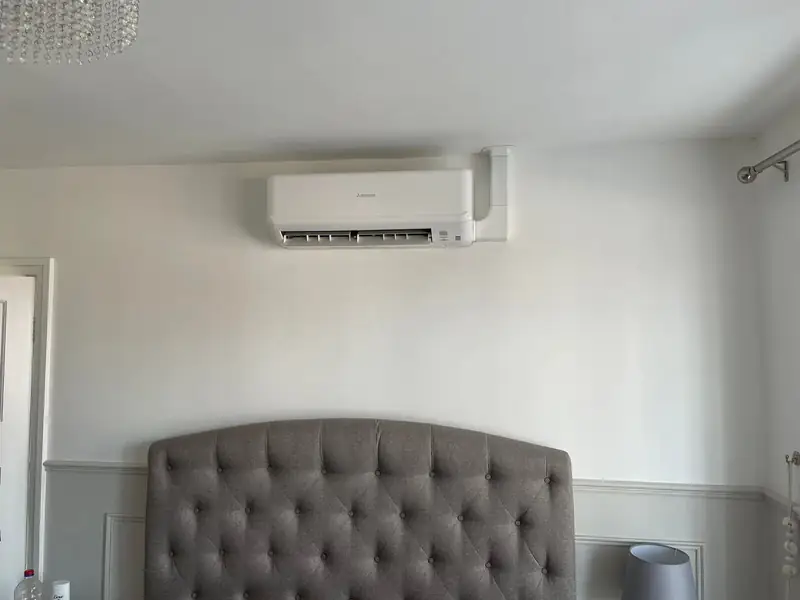
Most Wetherby households aren’t after whole-house cooling. They have one or two rooms that become unbearable in summer. Our domestic air conditioning work here is usually a single wall-mounted split, or a small multi-split covering two or three rooms.
| Room | Why it overheats | Typical approach |
|---|---|---|
| Conservatory or garden room | Large glazed area and roof, little thermal mass | Wall-mounted split sized for the glazing and orientation |
| Loft or top-floor bedroom | Heat rising and a warm roof above | Quiet low-capacity unit with a night mode |
| Home office | Computers, screens and closed doors | Small split with simple scheduling |
| Kitchen-diner extension< |