
Planned preventive maintenance compared with a one-off service
A one-off service and a planned preventive maintenance (PPM) arrangement involve much the same work on the day. They solve different problems, though. A service is a single visit that you remember to book. A PPM plan is a schedule: every indoor and outdoor unit you own is listed, each has an agreed visit interval, and the same checks are carried out and recorded every time, so no unit gets forgotten about for a season or two.
What a single service visit achieves
Our air conditioning servicing visit cleans filters, coils and fans, clears the condensate drain, checks electrical connections and tests the system in cooling and heating. For a homeowner with one wall-mounted unit, booking that once a year is usually all that’s needed. But it only tells you how the system looked on that one day.
What a PPM arrangement adds on top
- An asset register listing every unit, its location, model, refrigerant type and charge, so nothing is forgotten.
- Intervals set per system, not per building: a server room may be visited more often than the meeting room next door.
- A running history of readings and findings, which makes slow decline visible long before it becomes a breakdown.
- Planned timing agreed in advance, so visits land when they suit your trading pattern rather than when something has already failed.
- Forward planning: notes on which units are ageing, which parts are wearing and what to budget for over the coming seasons.
Good to know
Maintenance won’t make breakdowns impossible. It means most problems turn up as a line on a report, which you can deal with when it suits you, rather than as a dead unit on the hottest day of the year.
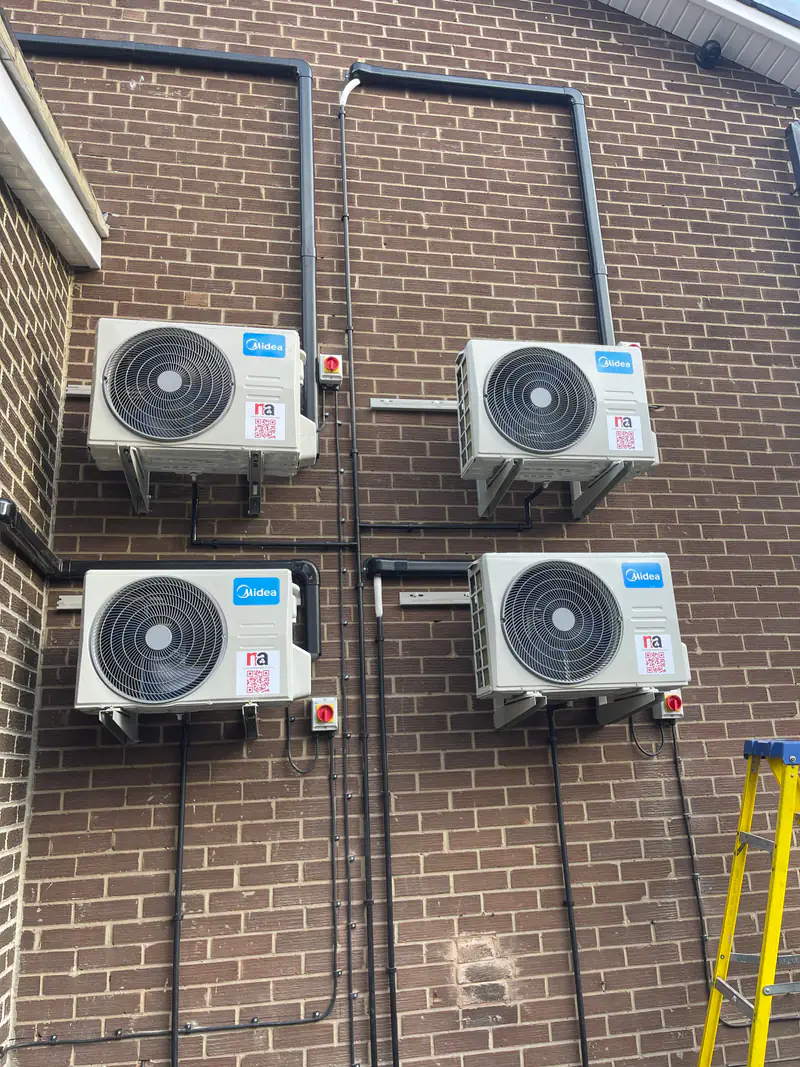
Who a PPM plan suits best
Planned maintenance earns its keep where the building can’t really function without its air conditioning, where there are several systems to keep track of, or where the person responsible for the kit isn’t the person using it.
Shops, cafés and salons
Systems that run long hours under heavy load, where a failure affects customers as well as staff. Our commercial air conditioning page covers these spaces in depth.
Offices and workplaces
Several indoor units across open-plan floors, meeting rooms and private offices, often with a mix of ages and installers. See office air conditioning.
Server and comms rooms
Cooling that protects equipment and often runs around the clock, where a clogged filter or a failing fan has real consequences.
Landlords and managing agents
Rental flats, HMOs and let commercial units, where you need evidence that systems are looked after and a single point of contact for tenants’ reports.
Homes with larger systems
Multi-split or ducted installations serving several rooms, where a reminder and a proper record save you chasing it every year.
How often should air conditioning be maintained?
Most air conditioning should be maintained at least once a year, and systems in busy, dusty, greasy or continuously running environments usually need visits every three to six months. The type of unit matters less than the air it’s handling and the hours it runs. We start from the table below and adjust once we’ve seen what’s actually on site.
| Environment | Typical usage | Suggested interval | Why |
|---|---|---|---|
| Home, single or multi-split | Seasonal, a few hours a day | Annually | Light dust load; filters cleaned by the householder between visits |
| Office or meeting rooms | Working hours, most of the year | Annually to twice a year | Moderate dust and occupancy; comfort complaints are the main risk |
| Retail shop floor | Long trading days, doors opening | Twice a year | Street dust and fibres from stock load filters quickly |
| Café, restaurant or bar | Long hours, cooking nearby | Quarterly to twice a year | Airborne grease coats coils and fans and holds dust |
| Hair or beauty salon | Long hours, products and hair in the air | Quarterly to twice a year | Aerosols, fine hair and chemical vapours foul filters and coils |
| Gym or fitness studio | Peak loads, high humidity | Quarterly to twice a year | Heavy moisture and lint; condensate drains work hard |
| Server or comms room | Continuous, all year | Quarterly | Failure has direct consequences; fans and drains run constantly |
| Rental property between tenants | Varies | Annually plus at changeover | Confirms condition before a new tenancy and records it |
Factors that shorten the interval
- Units near kitchens, extraction outlets or busy roads.
- Outdoor units under trees, beside car parks or on roofs where litter and leaves collect.
- Systems with a history of drain blockages, ice on the indoor coil or nuisance trips.
- Equipment protecting stock, medicines or IT where a temperature excursion is costly.
- Older systems where components are near the end of their working life.
When an annual visit is enough
A lightly used unit in a clean room, with filters washed regularly by whoever uses it, rarely needs more than one professional visit a year. We’d rather start with a longer interval and shorten it if the findings call for it than sell you visits you don’t need.
Inside a planned maintenance visit
Each scheduled visit follows the same checklist, unit by unit, so that readings from one visit can be compared with the last. On a typical wall-mounted or cassette indoor unit the routine takes roughly an hour; ducted units, large outdoor units and units with awkward access take longer.
Indoor unit tasks
- Remove, clean and refit filters, or replace them where they are damaged or disposable
- Clean the evaporator coil and inspect fins for damage
- Clean the fan barrel and casing, where mould and dust tend to build up
- Flush and test the condensate tray, drain line and any condensate pump
- Check louvres, swing motors and the remote or wall controller
- Treat for odours where needed and check for signs of water staining around the unit
Outdoor unit tasks
- Clear leaves, litter and debris from the coil and the surrounding area
- Clean the condenser coil and check fins and guards
- Inspect fan blades, anti-vibration mounts, brackets and fixings
- Check pipe insulation, trunking and any wall penetrations for damage
- Confirm the unit still has the airflow clearances it needs
Performance and safety checks
Refrigerant circuit
We measure operating pressures and temperatures and compare them with the last visit and with what the system should be doing. A gradual change over several visits is often the first sign of a slow leak or a failing component. Any work that involves opening the refrigerant circuit must be carried out by someone holding the appropriate F-Gas certification.
Electrical supply and controls
Terminals are checked for tightness and signs of overheating, the isolator is inspected, and running current is noted. Controls, timers, sensors and any building management or app connection are tested so the system behaves as the occupants expect.
After the visit
You receive a written summary for each site: units visited, tasks completed, readings taken, anything found and what we recommend, graded by urgency. Small adjustments are often made on the spot. Anything more significant is explained and priced separately so you can decide; our air conditioning repairs page explains how we approach faults.
Logbooks, records and F-Gas duties for operators
Records are the bit of maintenance that most often goes missing. A logbook kept with each system, or a digital equivalent covering the whole estate, turns individual visits into a history that you can use for budgeting, insurance questions, lease negotiations and decisions about replacement.
What a useful maintenance record contains
- Asset details
- Location, make and model reference, serial number, installation date where known, refrigerant type and charge.
- Visit log
- Date, who attended, tasks carried out and readings taken on each unit.
- Findings and actions
- Faults found, parts replaced, recommendations made and whether they were acted on.
- Refrigerant activity
- Any refrigerant added or recovered, the quantity and the reason, plus the results of any leak checks.
- Certificates and documents
- Commissioning sheets, electrical test results and any manufacturer documentation handed over at installation.
Do I need leak checks on my air conditioning?
Possibly: whether a system needs periodic mandatory leak checks under UK F-Gas rules depends on how much refrigerant it contains, expressed as a CO2-equivalent figure that combines the charge weight with the refrigerant’s global warming potential. Many small single-room units fall outside those requirements, while larger commercial systems and multi-unit installations are more likely to be covered, with the required frequency rising as the charge increases. It depends on the specific equipment, so record each system’s charge on your asset register and work out its obligations from there.
Who counts as the operator
Responsibility generally sits with the operator, meaning whoever has actual control over the equipment, which is often the business occupying the premises rather than the landlord or the installer. Operators are expected to prevent leaks, arrange any required checks through suitably certified people and keep records. If your lease is vague about who looks after plant, get it agreed in writing.
Energy inspections for larger systems
Separately from F-Gas, buildings with larger air conditioning installations above a set cooling output may need a periodic energy assessment of the system, commonly called a TM44 inspection. A tidy maintenance record makes that process simpler.
Ask to see certification
Anyone installing, servicing or repairing equipment that contains fluorinated refrigerant must hold the appropriate F-Gas certification. You’re entitled to ask any contractor, us included, to show it before work begins.
Multi-site and multi-system estates
Once air conditioning spreads across several buildings, or a single building has a mixture of systems from different installers, keeping on top of it is as much an admin job as an engineering one. A plan puts it all on one schedule with one set of records.
Building an asset register
The first visit is a survey of everything: indoor units, outdoor units, controllers, condensate pumps and any standalone units. Each gets a reference that appears on site labels and on reports, so a store manager reporting “the cassette by the fitting rooms” and an engineer reading a report are talking about the same piece of equipment.
Scheduling visits across several premises
We group visits by location to cut travel and disruption, so premises in the city centre and in Acomb might be covered in one run and sites in Selby and Tadcaster in another. Critical spaces such as comms rooms are timed so they are never all serviced on the same morning.
Consistency between sites
- The same checklist and report format at every location, so sites can be compared directly.
- Filter sizes and common consumables noted per unit, so replacements are on hand.
- One schedule showing what is due where, which helps when budgets are set centrally.
- Clear notes on access arrangements, keys, alarm codes and permit requirements for each site, kept with the site record rather than on someone’s phone.
Setting up a maintenance arrangement
It doesn’t matter whether we fitted the systems or someone else did. Getting started works the same way.
Initial survey of every unit
We record each indoor and outdoor unit, its condition, access and refrigerant details, and flag anything that needs putting right before routine visits begin.
Agreeing intervals and timing
Using the environment and usage of each system, we propose a visit frequency and discuss timing around your opening hours. Early, late or closed-day visits can be discussed by arrangement.
Written proposal
You receive a clear scope covering units included, tasks per visit, visit frequency, reporting and how additional work is handled, so you can compare it with other proposals.
Scheduled visits and reports
Visits go ahead as planned, each followed by a report and an updated record for every unit.
Annual review
Once a year we look back at the findings and adjust intervals, flag units approaching end of life and update the asset register for any changes to the building.
Budgeting for maintenance and cutting breakdown risk
The cost of a maintenance arrangement is driven mainly by how many units are included, how often they are visited and how easy they are to reach. We don’t publish price lists. Two estates with the same number of units can be completely different jobs.
What affects the cost of a maintenance plan
- Number and type of indoor units: ducted and high-level cassettes take longer than wall-mounted units.
- Visit frequency for each system.
- Access: roof-mounted outdoor units, high ceilings, ladders, scaffold towers or permits to work.
- Number of sites and the travel between them.
- Out-of-hours visits arranged to avoid trading time.
- Whether consumables such as replacement filters are included or charged as used.
- Any leak checks and record-keeping required for particular systems.
What a maintenance quote should spell out
- A list of the units covered, ideally by reference and location
- The tasks carried out on each visit
- Visit frequency and how visits are scheduled
- What reporting you receive and in what format
- How faults found during a visit are quoted and approved
- Whether any leak checks or statutory records are included
Does planned maintenance actually prevent breakdowns?
It reduces the most common causes rather than eliminating them. Many call-outs trace back to things a maintenance visit deals with routinely: blocked filters causing coils to ice, condensate drains overflowing, outdoor coils choked with debris, loose terminals and fans running on worn bearings. Catching those early usually costs less and causes less upheaval than an urgent repair. You can also plan bigger work for the quiet months, and if something does fail, our repair service starts from your records rather than from scratch.
Care between visits for staff and tenants
A few habits between visits make a real difference, and they’re easy to add to a weekly opening checklist or a tenant welcome pack. Homeowners with a system at home can follow the same list.
- Wash the indoor unit filters as the manufacturer recommends, more often in dusty or busy spaces
- Keep furniture, stock and boxes away from indoor units so air can circulate
- Keep outdoor units clear of leaves, bins, plants and stored items, and never cover them while they could run
- Set a sensible temperature, not the lowest one. The room won’t cool any faster
- Close doors and windows while cooling or heating
- Report new noises, smells, drips or error codes promptly, with the unit reference if it has one
Warning signs worth reporting straight away
- Water dripping from an indoor unit or staining on the wall below it.
- Ice forming on pipework or the indoor coil.
- A unit that runs constantly but no longer reaches its set temperature.
- Burning, electrical or persistent musty smells.
- The isolator or circuit breaker tripping.
Planning ahead for ageing and end-of-life systems
Sooner or later, keeping a system going costs more than it saves. Maintenance records make that point visible in advance, so replacement can be planned and budgeted rather than forced on you by a failure in July.
Is my air conditioning still running on R22?
If the system was installed a long time ago it may be, and if so it cannot be serviced with refrigerant: since the start of 2015, R22 can no longer be used to service or top up air conditioning in the UK, whether new or recycled. An R22 system can keep running while it remains sealed, but once it develops a refrigerant leak or a compressor fault there is no lawful way to recharge it with R22. The refrigerant type is shown on the outdoor unit’s rating plate, and we record it on your asset register.
Repair, nurse along or replace
When a unit is ageing, the realistic options are to keep maintaining it and accept a rising risk, to carry out a significant repair, or to replace it as part of a planned programme. Which makes sense depends on the fault history, parts availability, refrigerant type, efficiency compared with current systems and how critical the space is. Where replacement makes sense, our air conditioning installation service can phase the work across an estate so that the most vulnerable systems are replaced first.
If you would like a maintenance plan for premises in York or the surrounding towns, get in touch for a free, no-obligation quote or call 0191 743 9144.